
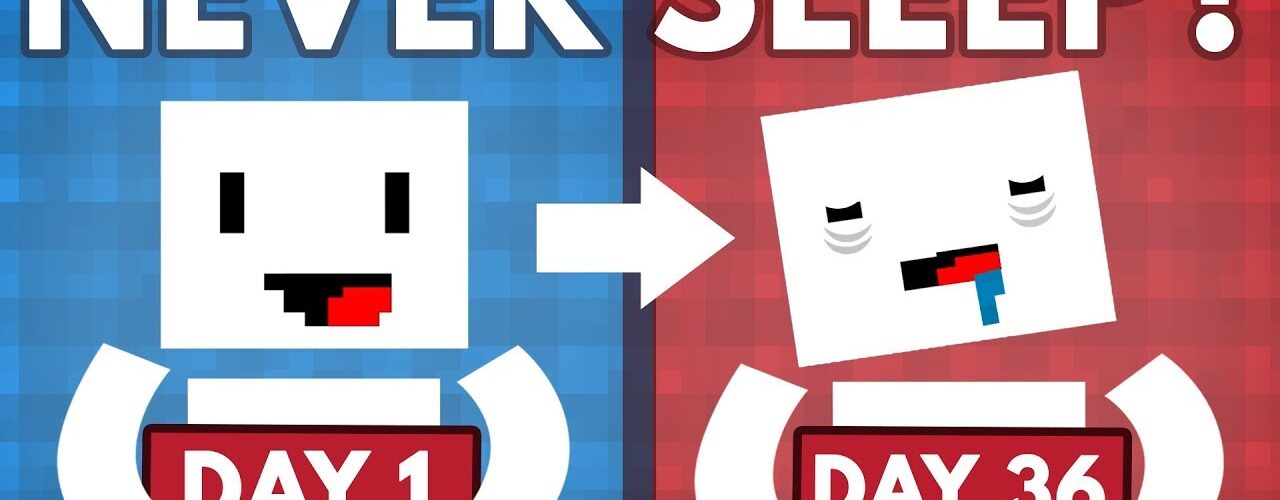
Introduction: What Happens If You Don’t Sleep for a Week?
Hey there! Welcome to Life Noggin! We’ve talked before about the importance of sleep and how much you should try to get each night, but we haven’t seen what it would be like if you didn’t sleep at all. Obviously, please don’t try this—it’s just hypothetical.
James: AHHH!
Blocko: …Uh…
James: Where am I, and why am I so pointy!?
Blocko: Animator, why does he get a face!?
James: Hey, aren’t you Block Man from…uh…Life Nugget.
Blocko: Close enough, I guess. Who are you?
James: I’m James from TheOdd1sOut.
Blocko: Oh yeah! I know you! You’re normally a lot rounder.
James: But now I’m looking sharp!
Both: AYYYY!
What Happens to Your Body If You Don’t Sleep?
Blocko: So, I don’t know if you’re busy after crashing through a giant portal in the sky, but do you wanna help me with this video?
James: Sure! What’s it about?
Blocko: Oh, it’s on what would happen if you didn’t sleep for a week!
James: Oh yeah, I can definitely help with this one. So, going without sleep for a week sounds like a long time, but you wouldn’t win any awards for doing it.
There has actually been a well-documented case where someone stayed awake for about 11 days, or nearly 265 hours. This was Randy Gardner, a high school student in San Diego, California. While there have been other reports of people staying awake longer, Gardner’s case provides a detailed look at the upper limits of human endurance. He did it as part of an experiment for his science fair, breaking Tom Rounds’ previous record of 260 hours. All that for a science fair? I would have just gone with the baking soda volcano… or literally anything else!
Effects of Sleep Deprivation on the Body and Mind
Blocko: But what might happen to you if you stayed up for a week? After your first night awake, you might get lost in your video games until the sun surprises you through your window. Even 24 hours without sleep can lead to an altered sense of time and increased sensitivity to light.
As you progress into your sleepless week, you’ll likely notice your emotions becoming unstable. You might feel less positive and become easily irritated or disappointed. You could also experience memory issues and have trouble staying alert. Sleep loss weakens the body’s ability to fend off illness, so avoid operating machinery, as the risk of accidents increases. Some people even report hallucinations after extended periods without sleep, though this is still debated. Oh, that’s not a hallucination. Sometimes that just happens.
Medical Conditions Related to Sleep
James: Beyond just choosing to go without sleep, there are also medical conditions that make sleep difficult, and some are pretty serious. One of these is called exploding head syndrome. It’s not actually as cool as it sounds—it’s worse. This condition causes people to experience extremely loud noises, like explosions or thunderclaps, as they’re drifting off or waking up. High stress, mental fatigue, or physical fatigue can make people more prone to this syndrome, and it can truly interfere with their sleep.
Fatal Familial Insomnia
Blocko: Another condition is called fatal familial insomnia, where patients experience progressive insomnia, weight loss, extreme body temperatures, and rapid-onset dementia. There’s currently no effective treatment or cure, and death typically occurs within 12-18 months of the first symptoms. However, research is ongoing. A recent study of five patients used SPECT and PET scans to show that fatal familial insomnia affects the basal ganglia and cerebral cortex, which are important in regulating sleep-wake behaviors. Hopefully, with further research, we’ll find a way to better care for this disease and one day discover a cure.
Can Sleep Deprivation Help With Depression?
James: Serious conditions aside, sleep deprivation doesn’t always have negative effects. Not that I’m encouraging you to stay up all night, but a recent study found that sleep deprivation might be an effective antidepressant. It rapidly reduced symptoms of depression in roughly half of the depression patients analyzed. Their results are really interesting, but generally, sleep is super important, and you should try to keep your brain well-rested—at least in most cases.
Outro: Let’s Aim for the World’s Largest Sleepover Instead!
Blocko: Rather than trying to see how long you can stay awake, it’d be way cooler if we tried to beat the world record for the largest sleepover party. It’s only 2,004 people! If more people fall through that giant portal thing, we could probably beat that record. Actually, never mind. Let’s get out of here. Why!? It looks so friendly! Who’s a good fish monster!?
So, how long have you stayed up for? Let me know in the comment section below! Thank you so much to James from TheOdd1sOut for helping me with this video! He’s incredibly talented and makes amazing animated stories on his channel. Go check him out and subscribe!
Subscribe to Life Noggins Youtube Channel and as always, I’m Blocko, and this has been Life Noggin. Don’t forget to keep on thinking!
Video Sources:
• What would happen if you didn’t sleep…
https://rarediseases.info.nih.gov/dis…
https://www.sciencealert.com/watch-he…
http://www.guinnessworldrecords.com/w…
http://www.digitaljournal.com/article…
http://www.neatorama.com/2007/10/24/e…
https://www.nature.com/articles/s4159…
http://onlinelibrary.wiley.com/doi/10…
https://www.huffingtonpost.com/entry/…
https://www.uni-bonn.de/Press-release…
https://www.livescience.com/52592-spo…
https://health.clevelandclinic.org/20…
https://www.ncbi.nlm.nih.gov/pubmed/2…
https://www.livescience.com/45532-exp…
http://www.sleepeducation.org/sleep-d…
https://www.ncbi.nlm.nih.gov/pmc/arti…







Add comment